
In 2006, I became a Board Member representing Sheffield University in the AIMEA-UK Academic Initiative in the More Electric Aircraft Consortium (Sheffield, Nottingham, Bristol, Manchester and Newcastle Universities) which we formed in order to join the EU MOET Programme bid with Airbus.
A consortium of 61 companies, including Rolls-Royce, Goodrich, EADS, QinetiQ, and Airbus successfully bid for the €66 608 978 EU Framework Project
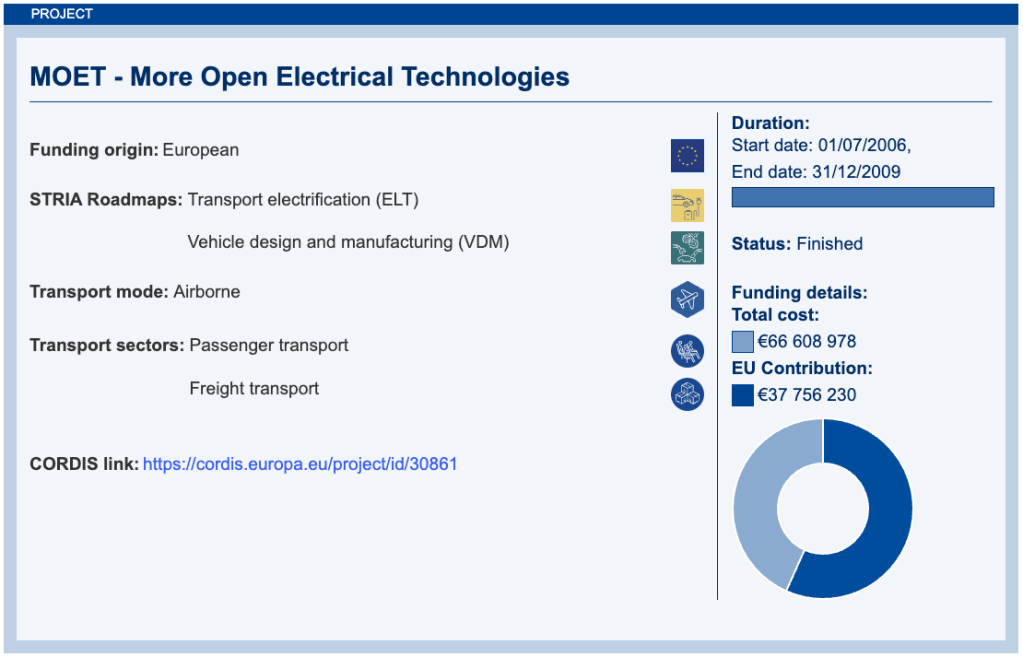
Overview
Background & policy context:
In line with Vision 2020, MOET aimed to establish a new industrial standard for commercial aircraft electrical system design, which will directly contribute towards strengthening the competitiveness of the aeronautical industry. The project also contributed to reducing aircraft emissions and improving operational aircraft capacity.
Recent national and European research activities and state-of-the-art commercial aircraft developments have launched more advanced approaches for onboard energy power management systems. These benefits have also been recognised in North America where they are being given special consideration.
A step change is necessary to remove current air and hydraulic engine off-takes and further increase the electrical power generation capability. This in itself will require significant changes to current electrical generation and network techniques.
After Fly-by-wire, the Power-by-wire concept (PbW) will enhance aircraft design and use by power source rationalisation and electrical power flexibility. This will be achieved by developing the necessary design principles, technologies and standards.
Objectives:
The overall purpose of the project was to develop the so-called ‘Power by Wire’ or ‘More Electric Aircraft’ concept. This concept involved significant changes in power management aboard commercial transport aircraft, which so far have not been achievable due to technology limits.
- The five top-level objectives of MOET Project were as follows:
Objective 1: Define and validate new electrical networks up to 1MW
Deliverables: Innovative electrical network principles (full 230VAC, full ±270VDC or mixed network) up to 1MW for a broad range of aircraft matching with More-Electric Aircraft needs validated through component, equipment and network simulations and tests.
Objective 2: Resolve and validate transformation of users into all electrical solutions
Deliverables: For air conditioning, wing ice protection, cooling and actuation systems validating the transformation into all electrical solutions with validation by hardware such as integrated smart power pack or jamming-free EMA, tests and/or simulation.
Objective 3: Develop and validate power electronics enabler technology
Deliverables: A representative set of integrated power electronics converters validating high performance technology capability based on potential innovative new standards.
Objective 4: Integration into aircraft
Deliverables: A set of studies validating More-Electric technologies integration into aircraft and highlighting new installation constraints and opportunities.
Objective 5: Develop a coherent design environment to support More-Electric Aircraft design and validation
Deliverables: A set of simulation and integrated rig platforms enabling future More-Electric technology development, validation, optimisation and assessment. - Through the combination of the project objectives, the following results were expected at aircraft level:
- Fuel burn: 2% less, considering results from previous European Project POA
- Maintenance: 15$ cheaper per flight hour, considering results from previous European Project POA
- Unexpected delays for systems: 50% less for power systems
- Power electronics weight reduction: 50% less than 2005 state-of-the-art
- System improvement: enhanced competitiveness, manufacturing improvement, technology validation & standard proposals
Methodology:
Vertical workflow was organised in Work Packages (WP) where:
- WP1 was dedicated to architecture driven by WP1.11, which provides the aircraft view.
- WP2 to 6 were dedicated to component, equipment & sub-system development which were divided into 4 parts.
- WP2.11 to WP6.11 dealt with system architecture and specifications,
- WP2.2x to WP6.2x dealt with technology development and validation in accordance with the architecture specifications. These work packages played a key role between the architecture Working Group and the models for the validation platforms.
- WP3.31 to WP6.31 dealt with the equipment models for the simulation platform and equipment for the integration rig platform.
- WP3.32 to WP6.32 dealt with the power electronics standards development.
- WP7 was dedicated to simulation, driven by WP7.11 which provides the validation plan for the validation platforms.
- WP8 was dedicated to system integration testing, driven by WP7.11 which provides the validation plan for the validation platforms.
Horizontal (transverse) workflow, where WP0 was dedicated to consortium management and three ‘Working Groups’ ensured consistency across the Work Packages from architecture definition up to rig validation:
- (1): Architecture Working Group aimed at designing the More-Electric-Aircraft concepts and assessing them against aircraft references for a broad range of aircraft sizes and types. This Working Group was led by Joel Audouard-Monteils, AIRBUS S.A.S.
- (2): Validation platform Working Group aimed at supporting development and validation of a consistent design environment dedicated to More-Electric technologies. This Working Group was led by Johann Bals, DLR and Matthieu Margail, AIRBUS OPERATIONS S.A.S.
- (3): Power electronics Working Group aimed at developing and validating enabler technology for power electronics. This Working Group was led by Olivier Tachon, AIRBUS OPERATIONS S.A.S.



 Prof Paul Stewart - University of Derby UK